CRM adoption: Why your team isn't using the CRM and what actually helps
91% of companies in Germany use a CRM, but only 35% of sales representatives trust their data. We show you how to recognise poor CRM adoption, what lies behind it, and how to get your team on board with the CRM using a 90-day plan.

Matthias Deimann
Founder & Managing Director
11 Oct 2026
14 min read

Monday, 9 am, pipeline meeting. Three salespeople, three Excel lists, and in the CRM are deals that no one has touched since April. Sound familiar? You are not alone. 91% of companies in Germany with at least 20 employees now use a CRM application, compared to 77% in 2022 (Bitkom, 2024). So almost every company has bought a CRM. Far fewer actually use it.
This article will help you find the cause and fix it. You will get a 30-minute check, the seven most common reasons for poor CRM adoption, a 90-day plan, and four key metrics to measure progress. Written for owner-managed B2B companies with 10 to 50 employees who already have a CRM and do not want to throw it away.
Summary: CRM adoption rarely fails because of the software. It fails because maintenance costs more than it brings to the salesperson, and because poor data creates mistrust. According to Salesforce (2024), only 35% of sales reps fully trust their data. The solution: clean up data, automate maintenance, lead by example, and check four key metrics weekly.
What does CRM adoption actually mean?
Only 35% of sales employees fully trust the accuracy of their company data (Salesforce State of Sales, 2024). CRM adoption is the willingness of a team to use the CRM voluntarily and daily as a central working tool because it helps them sell. So it means more than "everyone has a login".
The difference is important. Many managing directors measure adoption by the number of licences or logins. A salesperson who logs in to look up a contact and continues to manage their deals in Excel appears as an active user in this statistic. For you as the boss, they are still invisible.
True CRM adoption can be recognised by three things:
The CRM is the single source of truth. There is no parallel list that the team relies on in case of doubt.
The data is up to date. Every open deal has a next step with a date.
Decisions are made based on the CRM. Pipeline meetings, forecasts, and sales planning run directly from the system.
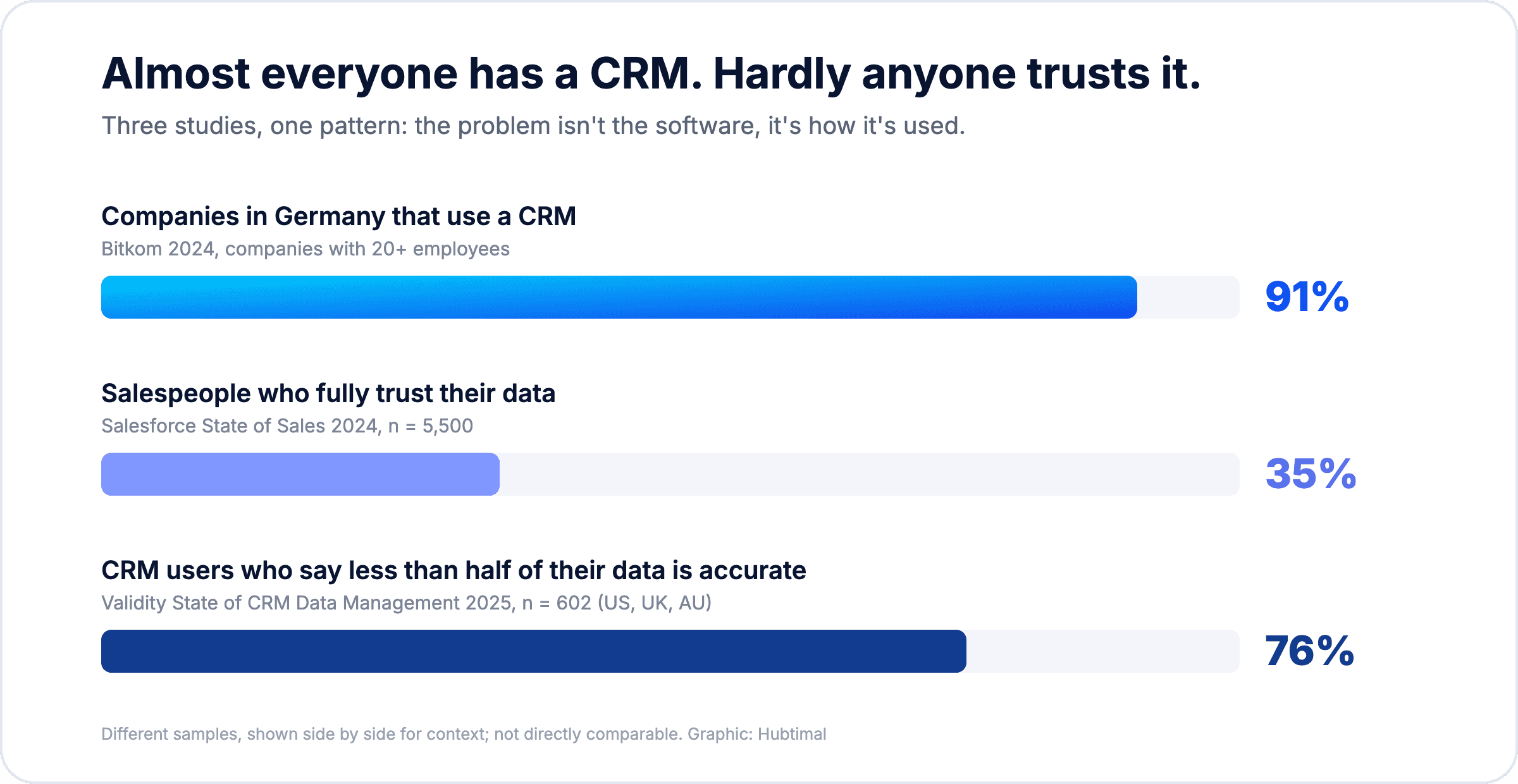
Sources: Bitkom 2024, Salesforce State of Sales 2024, Validity State of CRM Data Management 2025
The gap between ownership and trust is huge. 76% of CRM users say that less than half of the data in their CRM is accurate and complete (Validity, 2025). A CRM that no one believes in will not be maintained by anyone. And a CRM that no one maintains does not deserve trust. You must break this cycle.
How do you recognise that your team is not using the CRM?
According to Validity, 37% of employees regularly enter embellished or fabricated data into the CRM to show management what they want to see (Validity, 2025). A look at the dashboard is therefore not enough. You have to look specifically for warning signs, and that takes about 30 minutes.
The 30-Minute Check
Take half an hour, open your CRM, and go through these six points:
Warning sign | How to check it | Critical threshold |
|---|---|---|
Deals without a next step | Filter: open deals without a planned activity | more than 30% |
Abandoned deals | Filter: last activity older than 14 days | more than 25% |
Shadow lists | Ask two salespeople: "Where do you look first?" | Answer is not "in the CRM" |
Empty mandatory fields | Completion rate of the 10 most important fields | below 70% |
Duplicates | Search for identical company names and domains | more than 5% |
Pipeline meeting | What is the team talking about on Monday? | From memory or from Excel |
If more than half of the points trigger, you have an adoption problem. This is not bad news at first, because now you know your baseline.
Asking the two salespeople is the most important check. Do not ask if they use the CRM. Everyone answers yes to that. Ask where they look when a customer calls and they need to know what was last discussed. The honest answer is often the inbox.
The problem behind the problem
Poor CRM adoption costs you more than just a bit of visibility. According to Validity, companies lose an average of 16 deals per quarter due to poor data quality, and employees spend an average of 13 hours per week searching for basic information in the CRM (Validity, 2025). For a team of five salespeople, this quickly adds up to several full working days per week.
Why is your team not using the CRM? The 7 most common causes
Salespeople spend an average of only 40% of their time selling (Salesforce State of Sales 2026, 2026). So every additional mandatory field takes away from the scarcest resource your sales team has. Most adoption problems can be traced back to exactly this conflict.

Source: Salesforce State of Sales 2026, n = 4,050
1. The CRM takes more than it gives
This is cause number one. The salesperson maintains data, and the benefit lands with the boss in the form of reports. They get nothing back: no reminder, no prioritisation, no faster way to close. From their perspective, the CRM is a control tool that requires typing.
2. Too many fields, too many clicks
72% of salespeople feel overwhelmed by the number of skills they are expected to have, 50% by the amount of technology (Gartner, 2024). Overwhelmed salespeople are 45% less likely to achieve their quota, according to the same study. A deal form with 40 fields is a direct path to that.
3. Poor data destroys trust
Anyone who has called twice and found that the phone number was wrong will prefer to check their own mobile phone the third time. This happens quickly: In an evaluation of 75 data quality assessments, 47% of newly created data records had at least one critical error (Nagle, Redman & Sammon, Business Horizons, 2020). So errors occur at the time of entry, not just through ageing.
4. The sales process is not defined
When is a deal "qualified"? When does it move to "Proposal"? If every salesperson answers this differently, the pipeline is worthless, no matter how well it is maintained. The team notices this and stops trying. A CRM can only map a process that exists beforehand. Who is permanently responsible for the process and the CRM is a question of Revenue Operations. You can read more about this in our article Revenue Operations explained.
5. Leadership does not lead by example
The managing director who lets sales manager Thomas show him the Excel list in the pipeline meeting sends a clear signal: The CRM is optional. More on this in a moment, as this is the biggest lever in small companies.
6. Fear of being monitored
Transparency can feel like surveillance. Experienced salespeople in particular, who have known their customers for years, see their knowledge as personal capital. The CRM feels to them as if they have to hand over this capital. Ignoring it does not help here. You must be open about what the data is used for and what it is not.
7. Parallel worlds
Email, calendar, WhatsApp, LinkedIn, Excel, notebook. If the CRM is not connected to the channels in which sales actually works, it remains an additional system. Every piece of information must then be entered twice, and double work is the first thing to be cut.
Where does your CRM stand? The Adoption Matrix
The seven causes can be broken down into two questions. How much effort does maintenance cost the individual salesperson per day? And how much benefit do they get back for it? This results in four typical states.
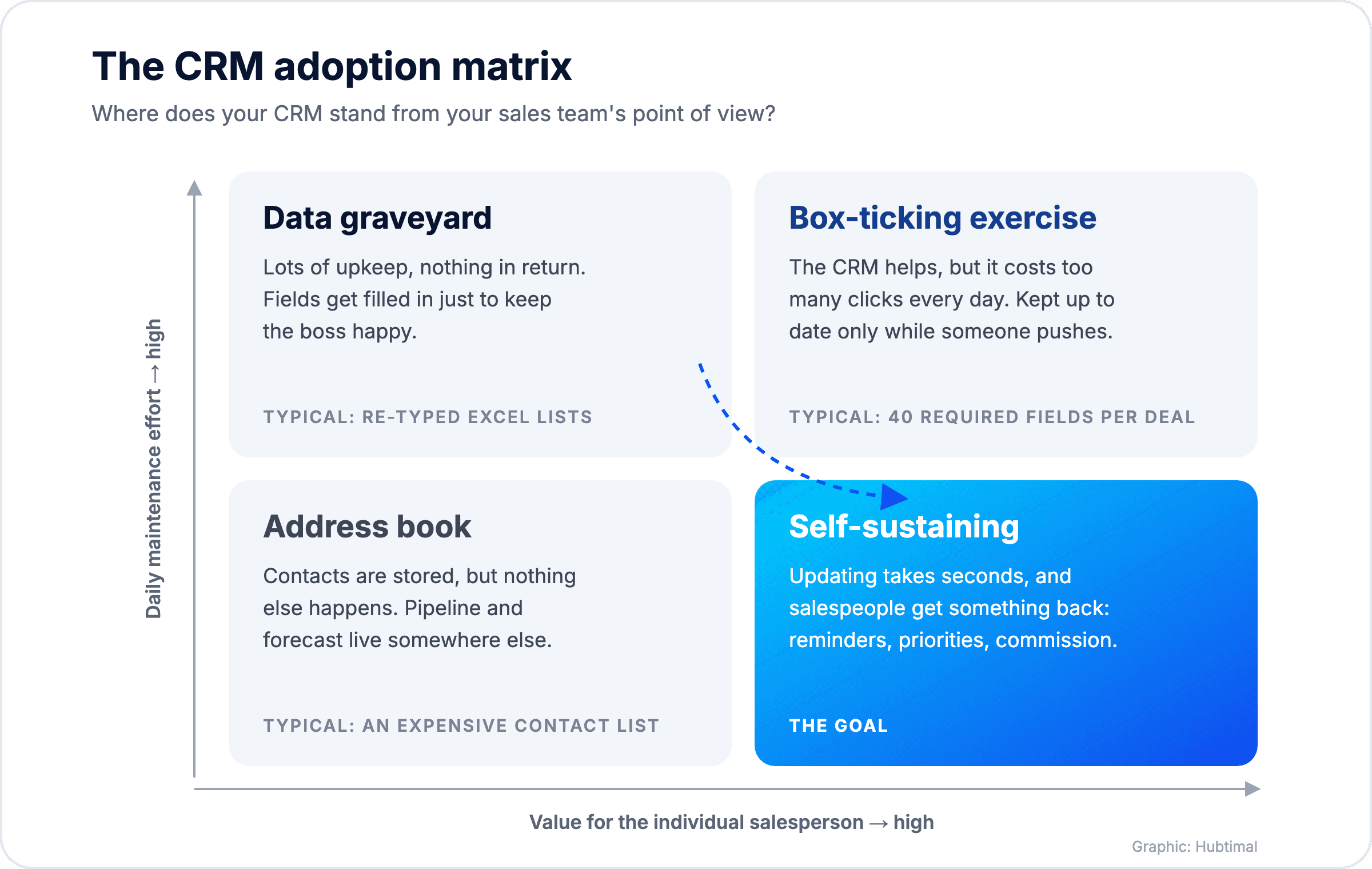
Graphic: Hubtimal
Most companies that come to us with an adoption problem are stuck in the data graveyard or the box-ticking exercise. The path to the self-sustaining quadrant almost always runs across both axes at the same time: effort down, benefit up. Those who only train without reducing the effort remain stuck in the box-ticking exercise. Those who only remove fields without giving something back to the salesperson end up with the address book.
What role does management play in CRM adoption?
Active support from leadership has been the most important success factor in change projects in every Prosci benchmark study since 1998 (Prosci). Projects with a highly effective sponsor meet their goals more than twice as often as projects with an ineffective sponsor. In a company with 30 people, this sponsor is the managing director themselves.
In addition, there is an uncomfortable number. 84% of executives say they change course when data suggests otherwise. Only 19% of CRM users actually experience this (Validity, 2025).

Source: Validity State of CRM Data Management 2025
For your team, this means: Why should I maintain clean data if, in the end, decisions are made from the gut? No one asks this question out loud. But it is behind every empty field.
A real-world example: A consulting company with revenues in the millions had long had a CRM. The sales reps used it only half-heartedly, and the numbers for management continued to come from manually built Excel reports. The data was scattered and never merged. No one could reliably say which channel actually brought in revenue. We built a unified reporting system directly from the CRM. This made it visible for the first time which channels delivered real revenue, and sales planning got a clear direction.
In owner-managed companies, we see one pattern particularly often. The most important pipeline is in the managing director's head. He knows the major customers personally, calls them himself, and enters nothing. The team sees this and draws the obvious conclusion.
Three things you as a managing director can do starting tomorrow:
Maintain your own deals in the CRM. Visible, complete, with a next step. The team sees that you are serious.
In meetings, only ask about what is in the CRM. If a salesperson talks about a deal that is missing there, the friendly answer is: "Enter it, then we'll talk about it."
Show that you act according to the data. If the pipeline shows that a campaign is not bringing in deals, stop it and tell the team why.
Increasing CRM adoption: the 90-day plan
79% of top performers in sales give data hygiene high priority, compared to only 54% of underperforming salespeople (Salesforce State of Sales 2026, 2026). So clean data is not a side issue for IT. Successful teams work this way. The following plan will get you there in three phases.
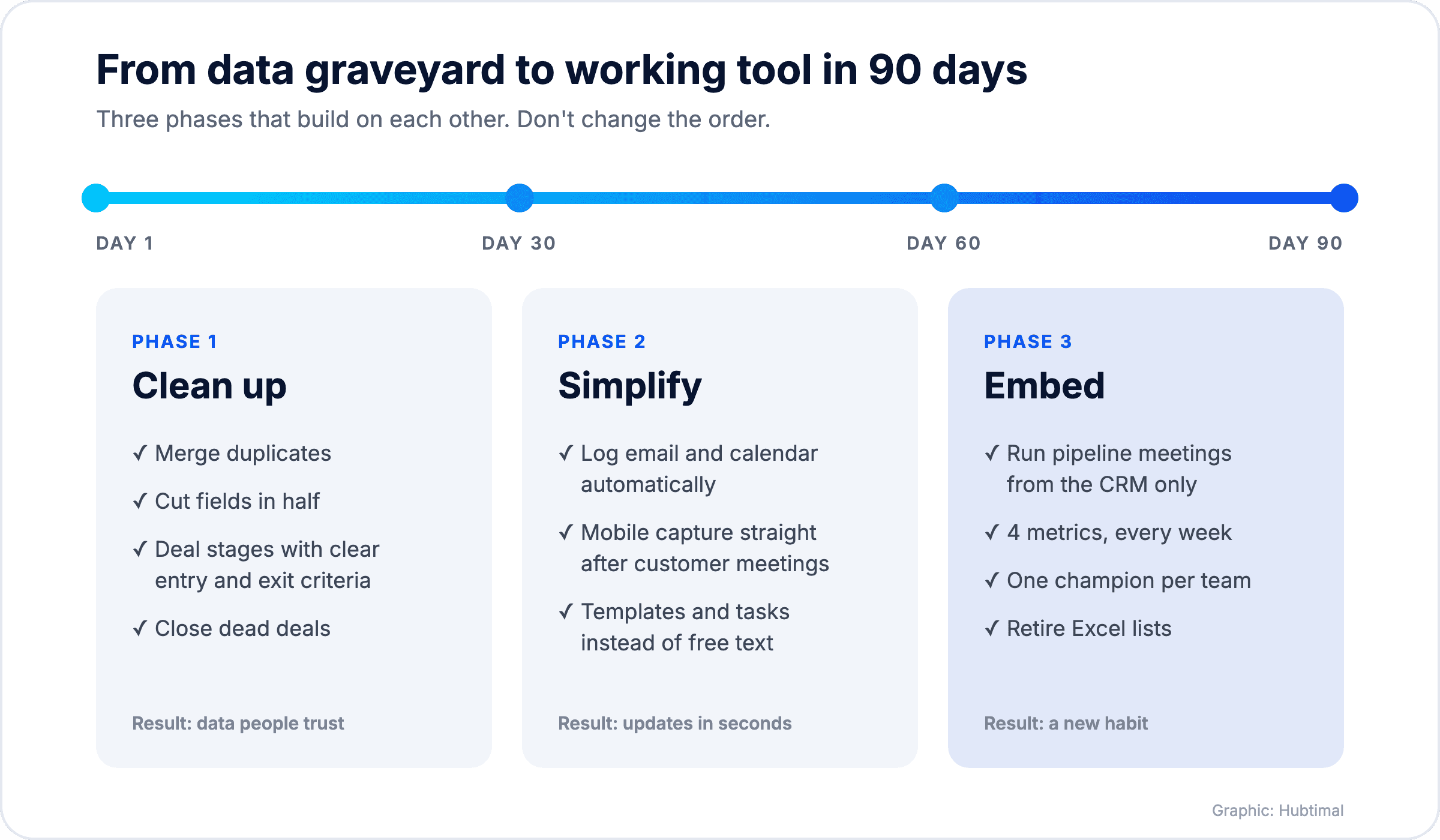
Graphic: Hubtimal
The sequence is important. If you start with training before the data is clean, you are training the team on a system they do not trust. If you automate before the process is clear, you automate chaos.
Phase 1 (Day 1 to 30): Clean up CRM data and create structure
At the end of this phase, you will have data your team trusts again, and a pipeline that everyone understands in the same way. This is how you proceed:
Do a field inventory. Export all fields for contacts, companies, and deals with their fill rate. Anything below a 20% fill rate is a candidate for deletion or hiding.
Halve the fields. One question applies to every field: What decision do we make based on this field? If there is none, it goes.
Merge duplicates. Define rules for which record wins, for example, the one with the most recent activity. Then merge companies first, and then contacts. Most CRMs have a built-in function for this.
Close dead deals. Every deal without activity for 60 days is briefly discussed with the owner and either revived with a new step or closed as lost.
Define deal stages. For each stage, write down an entry criterion that can be checked. Example: "Proposal" means a proposal has been sent and the decision-maker is known.
Clarify responsibility. Every contact, every company, and every deal has exactly one owner.
Important for subsequent CRM maintenance: Do not make fields mandatory everywhere, but only at stage transitions. A deal needs a name and a next step at the beginning. The budget only becomes mandatory when it moves into the proposal stage.
Phase 2 (Day 31 to 60): Simplify maintenance
Goal of this phase: Daily maintenance only costs each salesperson a few minutes. According to Salesforce, Gen Z salespeople lose around two full hours per week just to manual data entry (Salesforce, 2026). This is the time you win back here.
Connect email and calendar. Emails and appointments automatically end up with the right contact. This alone takes care of a large part of activity logging.
Set up mobile capture. Notes directly after the customer appointment via app or voice memo, not in the evening on the laptop.
Automatic tasks. If a deal changes to "Proposal", the CRM automatically creates a follow-up task in five days.
Templates instead of free text. Standard emails, call scripts, and meeting note templates save time and make data comparable.
Give something back to the salesperson. A daily task list, reminders of cold deals, an overview of their own commission. This is exactly where the CRM shifts in the matrix from "box-ticking exercise" to "self-sustaining".
Phase 3 (Day 61 to 90): Embed
Now the new system becomes a habit. Three measures have the greatest effect:
Pipeline meetings only from the CRM. Share screen, open pipeline view, go through it. What is not there is not discussed.
Appoint one champion per team. A salesperson who likes the system answers colleagues' questions and collects suggestions for improvement. This lowers the barrier to asking for help.
Turn off Excel lists. With a fixed date and prior announcement. As long as the old list exists, it remains the convenient alternative.
From now on, check four key metrics once a week. You can read which ones they are further down.
Free scoping workshop
Would you rather tackle the 90-day plan with support?
In the free scoping workshop, we spend 30 minutes looking at your CRM: setup, pipeline and the numbers your team gets out of it. Afterwards, you will know which phase to start with and what you can implement yourself.
Book a free scoping workshop
30 minutes · free · no obligation
How important is change management for CRM adoption?
Projects with excellent change management meet their objectives in 88% of cases, compared to only 13% for projects with poor change management (Prosci, 2023). That is about seven times as often. The numbers are based on self-reports from over 2,600 practitioners and show a correlation, not proof. The direction is clear nevertheless.
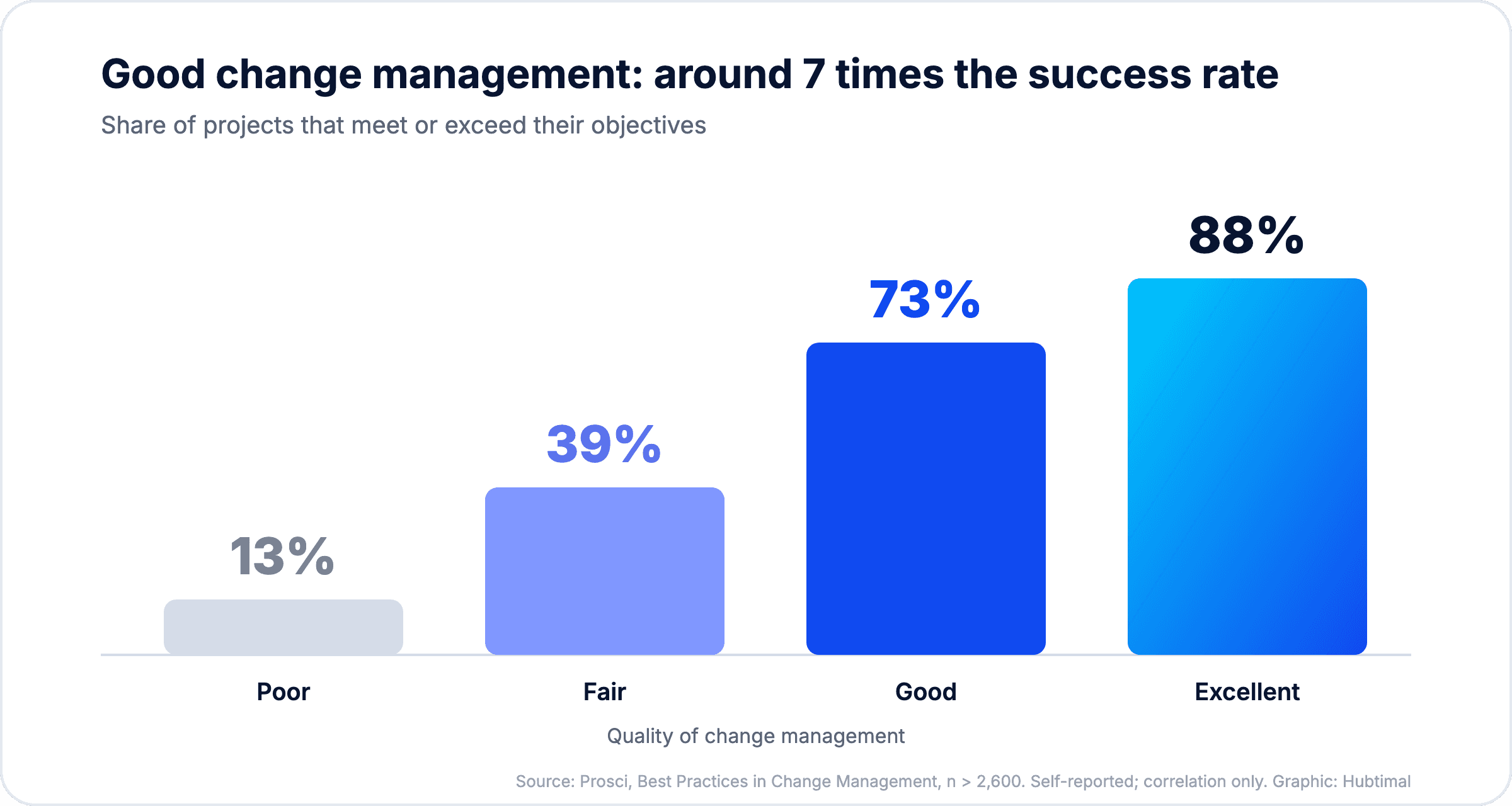
Source: Prosci, Best Practices in Change Management
Change management sounds corporate, like workshops and stakeholder analyses. In a company with 20 salespeople, that is overkill. But you also need the basic idea there: People only change their behaviour if they understand why, and if the new way is easier than the old one.
This is what CRM change management looks like in medium-sized businesses:
Involve two salespeople early on. Give them a say in the field inventory and the definition of the deal stages. They will later convince their colleagues.
Train on real deals. No feature tour through all menus. Every salesperson brings three of their own deals and enters them during training.
Learn in bite-sized sessions. Four 30-minute sessions beat one full day. After one day of training, half is forgotten before the first customer calls.
Make successes visible. If a deal is won because the reminder in the CRM came on time, share that in the next meeting.
Open a feedback channel. A Slack or Teams channel where anyone can report what is annoying. And then actually change something.
Training alone achieves little if the system remains complicated. Change management does not replace the cleanup work from phases 1 and 2. It ensures that it reaches the team.
How do you measure CRM adoption?
68% of executives believe their teams have sufficiently good data (Validity, 2025). Without measurement, CRM adoption remains a gut feeling, and that is obviously often wrong. Four key figures are enough to see the status honestly.
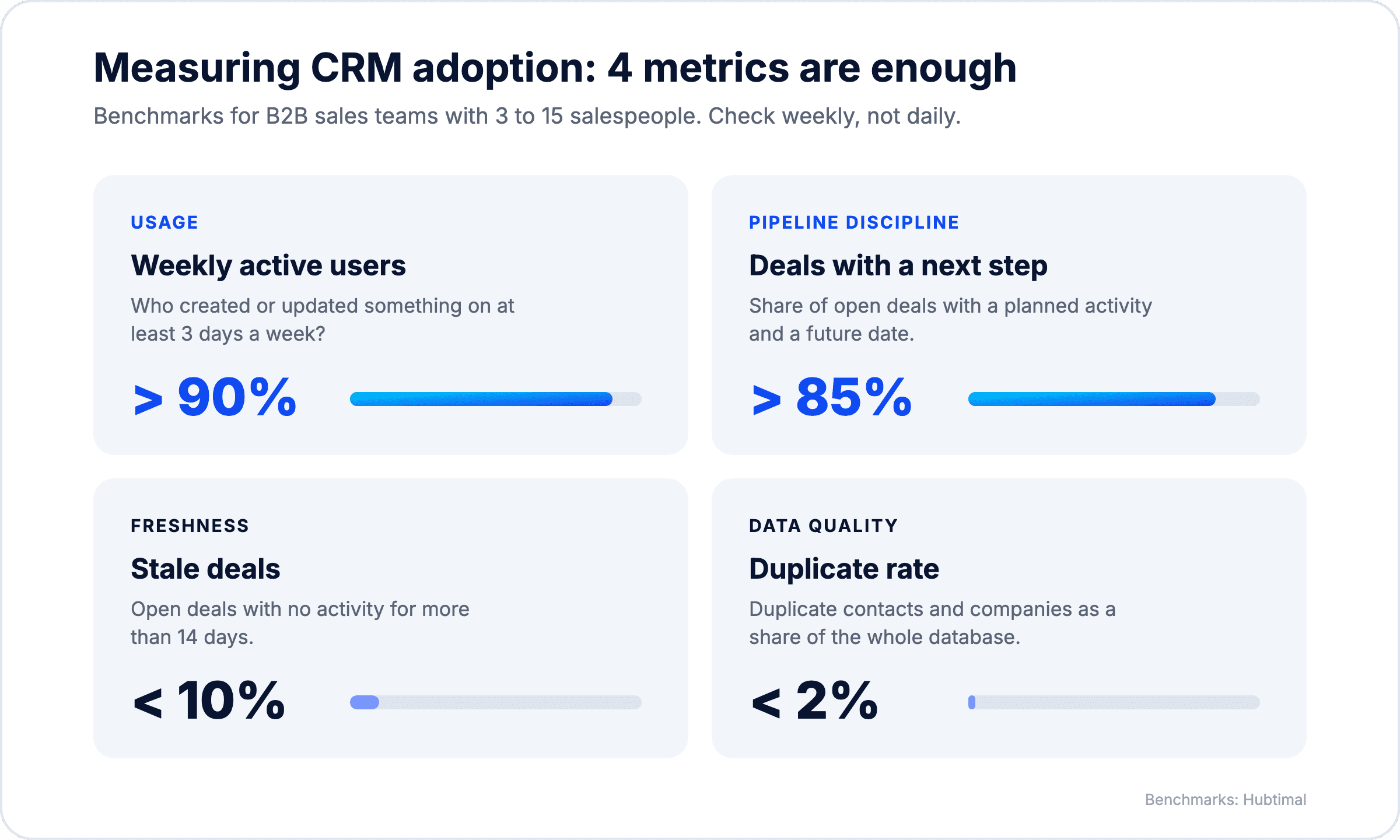
Benchmarks from Hubtimal for sales teams with 3 to 15 salespeople
Active users per week (Target: over 90%). Not logins, but individuals who have created or updated something on at least three days per week.
Deals with next step (Target: over 85%). Share of open deals with a planned activity and date in the future. This is the best single metric for pipeline discipline.
Abandoned deals (Target: under 10%). Open deals with no activity for more than 14 days. If the value increases, the team is losing track or is no longer logging.
Duplicate rate (Target: under 2%). Duplicate contacts and companies in relation to the total database. This is your early warning system for CRM data quality.
Build a single dashboard for this and look at it every Monday before the pipeline meeting. The values are benchmarks from our work with small B2B sales teams. More important than the exact target value is the direction: Are the numbers getting better week by week?
By the way, there is one metric you should deliberately not measure: the number of logins. It is easy to collect and says almost nothing about actual usage.
Could it be the CRM system after all?
Gartner analyst Ed Thompson described reports of widespread CRM project failures as "highly exaggerated" early on (CustomerThink). The often-cited figure "70% of all CRM projects fail" cannot be traced back to any primary study. It has been circulating for over 20 years without a reliable source. The tool is rarely the main reason for lack of adoption.
Before you think about switching, go through the 90-day plan. A new CRM with the same unclear processes and the same 40 mandatory fields will lead to the same result in a few months, only with migration costs on top.
However, there are cases where the system really does not fit:
The CRM is built for a different company size. An enterprise system with three levels of permissions is too heavy for twelve salespeople.
The most important channels cannot be connected. If email, telephony, or calendar are not cleanly integrated, double entry remains.
The costs are disproportionate to the usage. You pay for features that no one needs, while simple things are complicated.
Mobile usage is poor. This is a deal-breaker for field sales and trades.
Whether HubSpot, Pipedrive, Close, or another system: The right choice depends on your sales process, not on the feature list. If you are unsure whether your problem lies in the tool or in the process, a neutral outside perspective helps. That is exactly what our CRM consulting is for.
Frequently asked questions about CRM adoption
How long does it take to increase CRM adoption?
Expect around 90 days for noticeable change: 30 days of cleaning up, 30 days of simplifying, 30 days of embedding. Prosci shows that projects with good change management meet their objectives in 73% of cases (Prosci, 2023). A real habit in the team often takes a few more months of consistent leadership after that.
Should CRM logging be linked to commission?
This works if it is implemented fairly. A common rule is: Commission is only paid for deals that are in the CRM. Be careful with penalties for empty fields. According to Validity, 37% of employees already enter embellished data today (Validity, 2025). Pressure without benefit tends to reinforce this.
How often should you clean up CRM data?
Once thoroughly at the beginning, then continuously. Check the duplicate rate weekly and schedule a quick data check once a quarter. After an evaluation of 75 data quality assessments, 47% of newly created data records contained at least one critical error (Business Horizons, 2020). Clean entry is therefore more important than cleanup campaigns.
Is a CRM training session enough to improve adoption?
No, training alone is rarely enough. According to Gartner, 50% of salespeople already feel overwhelmed by the amount of technology (Gartner, 2024). More training on a complicated system changes little about that. First reduce effort and deliver value, then train on real deals in short sessions.
What does poor CRM data quality cost?
More than most people assume. According to Validity, companies lose an average of 16 deals per quarter because of poor data, and 37% of organisations directly lose revenue as a result (Validity, 2025). Added to this is an average of 13 hours per week that employees spend searching for information in the CRM.
Conclusion: Your CRM is not a software problem
Almost every company has a CRM today. The difference is whether the team actually works in it. The most important points summarised:
Measure adoption by behaviour, not logins. The 30-minute check shows you where you stand in half an hour.
The salesperson must get back more than they invest. This is the central question behind each of the seven causes.
Clean up first, then simplify, then embed. In that order, and not the other way around.
Management is the biggest lever. If you work in the CRM yourself and make decisions based on it, the team will follow.
Four key metrics, every week. Nothing more is needed to see the progress.
Free scoping workshop
Where does your CRM stand in the adoption matrix?
Together we look at how your team works with the CRM today and where the maintenance effort eats up the value. Afterwards, you will know which step will make the biggest difference for you: clean up, simplify or embed.
Book a free scoping workshop
30 minutes · free · no obligation
Blog
More articles
Matthias Deimann
Founder & Managing Director
14 min read
Duplicate companies, properties with no data, lifecycle stages with no logic: here is how you can tidy up HubSpot in five steps.
Matthias Deimann
Founder & Managing Director
17 min read
When is a lead an MQL, and when is it an SQL? Here is how you define lifecycle stages, lead status, and handovers so that marketing and sales speak the same language.
Matthias Deimann
Founder & Managing Director
14 min read
What RevOps means, how it differs from Sales Ops, and how you can get started with it in medium-sized businesses without a dedicated RevOps team.