What is RevOps? Revenue Operations for B2B SMEs
What is RevOps? Revenue Operations aligns marketing, sales, and customer service around shared data. The five building blocks and how to get started without a RevOps team.

Matthias Deimann
Founder & Managing Director
12 Oct 2026
14 min read

Imagine a typical Monday morning weekly meeting: Marketing reports 60 new leads from the last month. Sales says hardly any of them have made it into the pipeline. And no one can say how much revenue resulted in the end, because accounting doesn't track orders by channel. Everyone counts in their own tool and according to their own logic.
The fact that data is so scattered is not an isolated case: data and analytics leaders estimate in a Salesforce survey that 19% of their company's data is trapped in silos, inaccessible or unusable (Salesforce, 2025).
This is where Revenue Operations, or RevOps for short, comes in. In this article, you will learn what RevOps means, how it differs from Sales Ops and Marketing Ops, and which five building blocks it consists of. You will also get a five-step plan for getting started that works without a dedicated RevOps team, typical mistakes, and the metrics you can use to measure success. The article is aimed at owner- and founder-led B2B companies with 10 to 50 employees, regardless of which CRM you use.
In brief: Revenue Operations (RevOps) aligns marketing, sales, and customer service around shared data, shared definitions, and shared metrics. In mid-sized businesses, RevOps is rarely a department in its own right. It is usually a clearly assigned responsibility: one person ensures that the system works from the first contact to renewal. The five building blocks are data and CRM, processes and lifecycle, tools and tracking, reporting and forecasting, and a responsible person. Start small: clarify responsibility, take stock, define terms, clean up data, and introduce a shared dashboard.
What is Revenue Operations (RevOps)?
Revenue Operations, or RevOps for short (also written Rev Ops or Revenue Ops), is the approach of running all revenue-generating business areas as a single system. Marketing, sales, and customer service work with a shared database and consistent terms, and are measured against the same key metrics. Instead of three departments with their own tools and figures, there is an end-to-end process from initial contact to follow-up order. Forrester describes RevOps as a strategy that aligns and optimises data, processes, technology, and people to better serve the customer lifecycle (Forrester, 2023).
The term is made up of two parts. "Revenue" stands for everything that contributes to turnover, which also includes customer service and business with existing customers. This part is gaining importance: in a Gartner survey, 73% of sales leaders prioritised growth with existing customers for 2025 (Gartner, 2025).
"Operations" stands for the engine behind it: data, processes, tools, and reporting. So RevOps is less concerned with which campaign is running or which deal is closed next. It is about whether the system in which all of this happens is working reliably. There is no common German translation. Put simply, the term means running the entire revenue process.
RevOps originally comes from the US market and has established itself there as a role in its own right. In the LinkedIn ranking "Jobs on the Rise 2023" for the US, "Head of Revenue Operations" came first, measured by the growth of the role between 2018 and 2022 (LinkedIn, 2023). According to our observations, RevOps is still rarely a job title in German-speaking SMEs. The tasks behind it exist in every company anyway; they are usually just distributed among several people or simply don't get done.
We encounter two misunderstandings again and again:
RevOps is a tool. A new CRM doesn't resolve silos if the teams then continue to work with different definitions.
RevOps is reporting. A dashboard only shows what the underlying data provides. Without common definitions and clean data, it remains a prettier Excel sheet.
What RevOps means in a company with 10 to 50 employees
In large enterprises, RevOps is often a separate department with analysts, system admins, and a Head of Revenue Operations. In SMEs, the reality looks different: one person in marketing, three to eight people in sales, one or two people in customer service, and the managing director is involved in selling too. A dedicated RevOps department doesn't make sense here.
At this size, RevOps primarily means: one person is responsible for ensuring that marketing, sales, and customer service work on the same basis, and has the time and backing of the management to do so. In addition, there are a few binding rules and a shared view of the figures. We describe how we specifically set this up in projects on our page on Revenue Operations Consulting.
Why is RevOps relevant for SMEs?
RevOps is relevant for SMEs because the same friction points arise there as in large enterprises, just without the people to catch them. An example is time spent in sales: according to a Salesforce survey, sales reps spend only 40% of their working time actually selling (Salesforce State of Sales, 2026). In larger companies, sales ops teams handle data maintenance and analysis for the sales reps. In a company with 30 employees, these people usually do not exist.
You may recognise the typical symptoms:
The figures don't add up. Marketing, sales, and accounting come up with different values on the same topic.
You lose track after the handover to sales. No one can say how many leads from which channel ended up becoming customers.
The tool stack grows, but the benefit doesn't. Every team has its own tools, and there are more and more. According to Gartner, 50% of B2B sellers feel overwhelmed by the amount of technology, and overwhelmed sellers are 45% less likely to hit their quota (Gartner, 2024).
The forecast is a gut feeling. The forecast for the next quarter is created in the sales meeting, not from the pipeline.
The CRM costs a lot and delivers little. Licences are paid for, but the Excel list is opened again in the meeting.
These problems cannot be solved in a single department. No matter how well marketing qualifies its leads: if sales assesses them differently and does not feed back the results, no one learns. This gap between the teams is where RevOps comes in.
RevOps vs. Sales Ops vs. Marketing Ops: the difference
Sales Operations takes care of sales, Marketing Operations of marketing. Revenue Operations connects both and includes customer service. The difference lies in the perspective: Sales Ops and Marketing Ops optimise their section of the funnel, while RevOps optimises the handovers and the result at the end.
Function | Focus and tasks | Typical metrics |
|---|---|---|
Marketing Ops | Marketing: Marketing automation, campaign tracking, lead scoring. Reports to the head of marketing. | Leads, cost per lead, website conversion |
Sales Ops | Sales: CRM maintenance, pipeline, territory planning, commissions. Reports to the head of sales. | Win rate, pipeline, sales cycle length |
Revenue Operations | Entire revenue process: shared data and definitions, handovers, reporting across all teams. Reports to management (often to CRO or COO in corporations). | Pipeline generated per channel, conversion across all stages, forecast accuracy, revenue from existing customers |
In SMEs, these roles are rarely separated. Often, the marketing manager does marketing ops on the side, and the sales manager maintains the CRM on Friday afternoons. That's not a problem, as long as someone also keeps an eye on the stretch in between. In many companies that come to us, this view is missing.
The five building blocks of Revenue Operations
Revenue Operations consists of five building blocks: data and CRM, processes and lifecycle, tools and tracking, reporting and forecasting, as well as clear responsibility. The first four form the foundation on which all teams work. The fifth ensures that this foundation is maintained.

Graphic: Hubtimal
1. Data and CRM: a single source of truth
The foundation is a database that all teams trust. The CRM is the hub: every company, contact, and deal exists there exactly once, with the same mandatory fields for everyone. Excel lists, private address books, and data that only exists in the newsletter tool are brought back into the CRM or retired.
If your CRM has become cluttered over the years, it is worth cleaning it up first. We show you how to do this step-by-step in the article Cleaning up HubSpot chaos. The approach works in any CRM.
2. Processes and Lifecycle: the same language
Marketing, sales, and customer service need shared definitions. When is a contact a lead? When does sales take over? When is a deal a real opportunity, and when is a company considered a customer? Each of these phases needs a verifiable criterion and an owner. The handover from marketing to sales is particularly delicate, as this is where two teams with different objectives meet.
How to set up these phases with criteria, handover rules, and an SLA is described in detail in the article Setting up Lifecycle Stages correctly.
3. Tools and Tracking: few, but connected
RevOps does not mean buying more tools. Usually, the opposite is true: fewer tools that are cleanly connected with one another. For a company with 10 to 50 employees, in many cases a CRM as the hub, a tool for email marketing (often included in the CRM), clean website tracking, and a reporting tool (often also included in the CRM) are sufficient.
Disconnected systems are now also slowing down new initiatives: 51% of sales leaders using AI say that disconnected systems are slowing down their AI initiatives (Salesforce State of Sales, 2026). Anyone who wants to use automation or AI later needs connected data first.
More important than the number of tools is tracking the source. For every lead, the CRM should state which channel they came from. This is the only way you can say later which channel brings real pipeline and not just clicks. Whether your CRM is the right one for these tasks is something we clarify in our vendor-neutral CRM consulting.
4. Reporting and Forecast: figures everyone trusts
Once data and definitions are in place, a shared dashboard is worthwhile. It shows the funnel from initial contact to close, the pipeline per channel, and the forecast for the coming months. The crucial point is that all teams look at the same dashboard and no one brings their own figures anymore.
A good forecast comes from the pipeline, not from gut feelings. For this, every deal stage needs a clear meaning, and every deal needs an amount, an expected close date, and a next step.
5. Responsibility: one person keeps the system together
Without the fifth building block, the other four won't last long: one person must be responsible for the whole thing. They own the definitions, decide on new fields and tools, mediate between marketing and sales, and prepare the figures for the management. In our experience, without this role, even well-designed systems fall apart within a few months because each team starts adding its own logic again.
Quick test: How mature is your revenue system?
With five questions, you can find out where you should start. Each question belongs to one building block:
Data and CRM: Is every company listed exactly once in the CRM, and is no one looking for customer data in Excel lists anymore?
Processes and Lifecycle: Would marketing and sales give the same answer if you asked at what point a lead goes to sales?
Tools and Tracking: For every new deal in the CRM, does it show which channel the contact came from?
Reporting and Forecast: Do management, marketing, and sales look at the same dashboard in the monthly meeting?
Responsibility: Can you name the person who decides on new fields, tools, and definitions?
Every "No" shows you a building block where you can start. If you have three or more "Nos", it's best to start with responsibility, because without it, the other problem areas will stay unresolved.
How to start small: RevOps without a dedicated RevOps team
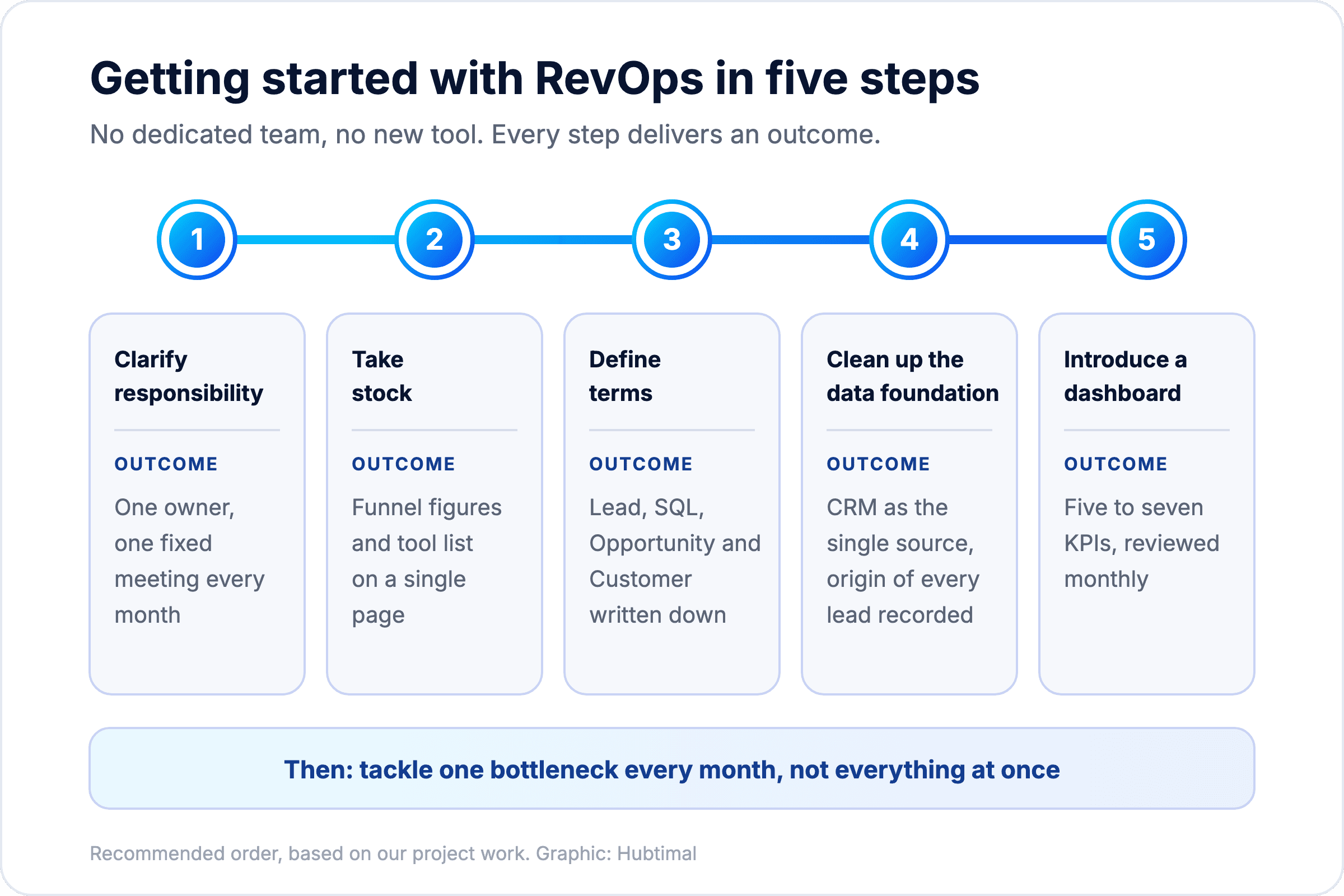
To get started with RevOps, you don't need a full-time RevOps manager or a new tool. Five steps are enough to turn teams working alongside each other into a first shared system.
Graphic: Hubtimal
Clarify responsibility. Appoint one person to take on RevOps alongside their current role, and give them a dedicated time allocation. Often, the marketing manager, sales manager, or someone from inside sales with a head for numbers fits well. It is important that the person represents both sides fairly and not just the goals of their own team. In addition, set up a regular monthly meeting with marketing, sales, and management.
Take stock. Gather the figures from the last quarter manually: new contacts, leads, initial meetings, proposals, closed deals, each with their channel. Alongside this, list all tools with their costs, users and purpose. Both fit on one page. The points where the figures don't match up are your first problem areas. From here on, you work as a team.
Define terms. Write down together what lead, sales-qualified lead (SQL), opportunity, and customer mean for you, and who is responsible for each stage.
Clean up the database. Make the CRM the single source: merge duplicates, define mandatory fields, track the source of every lead, eliminate shadow lists.
Introduce a dashboard. Select five to seven metrics that you discuss together every month. After that, address one bottleneck each month instead of everything at once.
In our experience, companies of this size manage the first four steps in about a quarter if the responsible person has about one day per week for it. This is a guideline from our project work and depends heavily on how many tools and legacy systems you bring along. It can be done faster, but then you need more person-days in the team or more budget for external support. In the end, you weigh speed against costs.
Who takes on the RevOps role?
For responsibility, there are three realistic options in SMEs:
Internal, with dedicated time: Someone from marketing or sales takes on the role additionally. This works if they are really given time for it and not just the title.
Externally guided: An external partner builds the foundation, facilitates the alignment between the teams, and then hands over to an internal person. This is how we work in our RevOps consulting.
Dedicated role: A full-time Revenue Operations Manager is usually only worthwhile once the foundation is in place and there is ongoing work, for example, due to multiple sales teams, countries, or product lines.
Where it usually gets stuck without help
The five steps sound manageable. In practice, it usually gets stuck on alignment rather than technology. Marketing and sales have to agree on definitions that have consequences for both sides. Someone has to decide which tools and fields to discard. And the responsible person needs to be freed up in day-to-day business. This is easier if someone facilitates who doesn't belong to either team and has already built several such systems.
Free scoping workshop
Want to set up RevOps without facilitating everything yourself?
In 30 minutes we look at your teams, your tools and the path from first contact to closed deal. You leave with a clear order: what to define first, what can go and who can take on the role.
Book a free scoping workshop
30 minutes · free · no obligation
Typical mistakes when introducing RevOps
The most common mistakes when introducing RevOps occur when companies start with tools or dashboards instead of responsibility and definitions. We see these seven time and again:
RevOps as a tool project. A new CRM or reporting tool is purchased, while definitions remain as they were. A year later, the new system is often just as cluttered as the old one.
Starting with the dashboard. The dashboard is the last step. Anyone who starts with it spends months debating figures whose definitions no one has clarified.
A title without authority. Anyone responsible for RevOps who is not allowed to make decisions on fields, tools, and processes ends up merely creating reports.
Everything at once. Attribution across all channels, lead scoring, AI automation, and forecasting all at once overwhelm a small team. One bottleneck per month is more realistic.
Optimising for marketing-qualified leads (MQLs). If you measure marketing on the number of leads, you get many leads. What matters is how much pipeline and revenue they generate.
Forgetting customer service. RevOps doesn't end with the close. Renewals, upsells, and referrals belong in the same system.
Not involving sales. Rules imposed on sales without their input get bypassed. Why this happens and what helps against it is described in the article CRM Adoption.
How to measure the success of RevOps
You measure the success of RevOps on three levels: on the output, on the handovers between teams, and on the quality of the foundation. Anyone who only looks at revenue will only see progress late. The metrics on the lower levels show earlier whether the system is taking hold.
Level | Metric | What question it answers |
|---|---|---|
Result | Pipeline generated per channel | Which channels bring real sales opportunities? |
Result | Win rate and sales cycle length | How well and how quickly do we close? |
Result | Forecast variance | How close was the forecast to actual revenue? |
Result | Revenue from existing customers | Is the business with existing customers growing? |
Handovers | Conversion per funnel stage | Where do contacts get stuck? |
Handovers | Time to initial contact after handover | Does sales respect the agreed deadline? |
Foundation | Share of complete data records | Are mandatory fields like channel, industry, and amount maintained? |
Foundation | Share of deals with next step | Is the pipeline being actively worked? |
A simple test shows you where you stand: how long does it take you to answer the question, "Which channels did the new customer revenue come from last quarter?" If the answer is one click away in the dashboard, your system works. If someone has to merge lists for an afternoon to find out, you know where to start.
Above all, compare these values with your own performance over time. Industry benchmarks for win rate or conversion depend heavily on how a company defines its stages, and are therefore rarely transferable. Measure the values every month and monitor the trend.
Frequently asked questions about RevOps
What does RevOps mean?
RevOps is short for Revenue Operations. It refers to the approach of running marketing, sales, and customer service as a single system, with shared data, shared definitions, and shared metrics. The goal is a seamless process from first contact to follow-up order, instead of three departments with their own tools and numbers.
What is the difference between RevOps and Sales Ops?
Sales Operations supports the sales department, with tasks like CRM maintenance, pipeline reports, and territory planning. Revenue Operations additionally includes marketing and customer service, focusing on the handovers between the teams. Sales Ops asks how sales can become more efficient. RevOps asks how a first contact reliably turns into revenue.
Is Revenue Operations only for software companies?
No. Many examples and guides on RevOps originate from the software industry, but the underlying problem is shared by all B2B companies with marketing, sales, and existing customers. Particularly in manufacturing SMEs and service providers, data is often stored in multiple systems, and visibility is lost after the handover to sales. RevOps works just as well there, just with different metrics.
Who is responsible for RevOps in a small company?
In companies with 10 to 50 employees, someone from marketing or sales typically takes on the role additionally, with a dedicated time allocation and support from the management. Alternatively, an external partner builds the foundation and hands over internally afterwards. A dedicated full-time role is usually only worthwhile later.
How do I know if my company needs RevOps?
Typical signs are numbers that don't match up between marketing, sales, and accounting, leads whose path after handover cannot be tracked, a forecast made from gut feeling, and a CRM that costs a lot but is replaced by Excel in meetings. As a rule of thumb: if two of these points apply, it's worth getting started.
Conclusion: growth needs a system, not another tool
RevOps is also worthwhile for small companies, because the underlying problem grows with the business: teams, tools, and figures work alongside each other instead of with each other. To get started, this sequence is enough:
Clarify responsibility. One person takes care of the whole system, with time and decision-making authority.
Take stock. Funnel figures and tools from the last quarter on one page show where things are stuck.
Define terms. Lead, sales-qualified lead (SQL), opportunity, and customer are defined the same way for everyone.
Clean up the database. The CRM is the single source of truth, and the origin of every lead is tracked.
Introduce a dashboard. Review the same metrics every month and tackle one bottleneck at a time.
Your next step
Where is your revenue system getting stuck?
Bring your numbers from marketing, sales and the CRM. Together we find the point where the most gets lost between first contact and revenue, and show you how to start there without a dedicated RevOps team.
Book a free scoping workshop
30 minutes · free · no obligation
Blog
More articles
Matthias Deimann
Founder & Managing Director
14 min read
Duplicate companies, properties with no data, lifecycle stages with no logic: here is how you can tidy up HubSpot in five steps.
Matthias Deimann
Founder & Managing Director
17 min read
When is a lead an MQL, and when is it an SQL? Here is how you define lifecycle stages, lead status, and handovers so that marketing and sales speak the same language.
Matthias Deimann
Founder & Managing Director
14 min read
Almost every company has a CRM, but hardly any team actually works in it. Here is how you can find the root cause and change that in 90 days.